 Guide
 Case study
 Guide
Can AI assistants read your website?
Some people now ask ChatGPT or Claude before they ask Google. Here is what we changed on our own site so assistants can read it, and the five things a small business should copy.
At a glance
- Site
- clandestinehours.com, our own
- What we changed
- A short llms.txt, a generated llms-full.txt, a plain-markdown copy of every note, structured data on the main pages, and a robots.txt that welcomes AI crawlers
- Stack
- Astro on Cloudflare Workers · schema.org JSON-LD · llms.txt convention
- Timeline
- One day, alongside a wider rewrite of the site
- Result
- Every offer, price rule, product status and note is available as plain text an assistant can read and quote. We have no traffic numbers from it yet.
When someone asks an AI assistant “who can build a booking site for a physiotherapy clinic in Portugal?”, the assistant often reads websites to answer. It reads them differently from a person. It usually doesn’t see your photos, your layout or the animation on your homepage. It mostly sees text. Text hidden behind scripts or inside images may not be read at all.
We rewrote our own site in October 2026 and checked it the way an assistant reads it. Here is what we found, what we changed, and what a small business can copy.
What an assistant actually sees
A crawler is the program that collects web pages for a search engine or an AI assistant. We fetched our homepage the way a crawler does, without running any JavaScript (the code that makes a page interactive), and read the raw text. Two things surprised us.
The headline came out garbled. Our main heading rotates one word (“automated”, “AI”, “digital”). To keep the layout steady, the page reserved space with hidden copies of every word. A person saw one clean sentence. A crawler read “into the automatedautomatedAIdigital age”. We moved the hidden copies out of the text, so the heading now reads as one sentence everywhere.
The second surprise was what was missing. Our prices, terms and the status of our own products were spread across several pages, some only in Portuguese. An assistant asked “how much does Clandestine Hours charge?” would have had to piece the answer together from several pages or guess.
What we changed
- A short
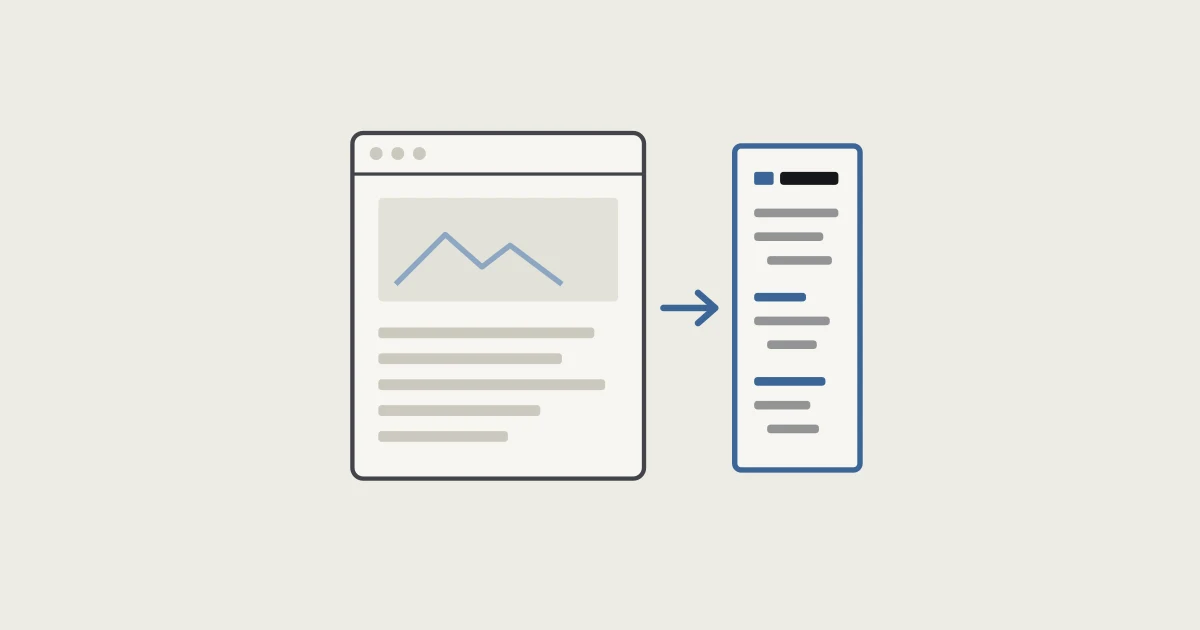
llms.txt. A plain-text file at the root of the site, following the llms.txt convention for summarising a site for AI assistants. It says who we are, what we do, for whom, how we price and how to get in touch, with links to the pages that matter. It is written by hand and kept short. - A full version, generated.
llms-full.txtputs our main offers, the FAQ, the status of every product and the full text of every note in one file. It is built from the same sources as the pages, so it cannot drift from what the site says. - A markdown copy of every note. Markdown is plain text with light formatting. Each note is also available as markdown at the same address ending in
.md, with diagrams replaced by their text descriptions. - Structured data. These are labels, hidden in the page, that tell machines what each piece of information is. Ours use schema.org JSON-LD. They describe who the organisation is, the FAQ as questions and answers, and each note as an article with its date and language.
- An open door.
robots.txttells crawlers what they may visit. Ours explicitly allows the main AI crawlers (OpenAI, Anthropic, Perplexity, Google, Apple and others) and keeps only private client areas closed.
What a small business should copy
You don’t need any of the files above to start. We think these five things matter more:
- Say the basics in plain text. What you do, where, for whom, your opening hours and how to book or ask for a quote. Write it as text on your own website. Keep it out of images, and don’t leave it only on Instagram.
- Answer the questions people actually ask. A short FAQ with direct answers is the kind of text an assistant can quote: “Do you deliver on Saturdays? Yes, in the morning.”
- Keep one source of truth. If your prices or hours live in three places, one of them will probably fall out of date. An assistant may find the outdated one.
- Don’t block the crawlers by accident. Some website builders and security settings block AI crawlers by default. If you want assistants to read your site, check your settings.
- Add structured data for a local business. Name, address, phone, opening hours, area served. Many website builders have a setting for it. Where they do, it takes minutes.
None of this guarantees that an assistant will recommend you. It does make it more likely that an assistant reading your site finds the right information.
Try this
Ask ChatGPT, Claude or Gemini: “What does [your business] do, where is it, and how do I book?” Compare the answer with the facts. Each wrong or missing detail may point to something your website either doesn’t say clearly enough or doesn’t say in text at all.