 Guide
 Case study
Models that only decide
A decision model answers one question with a probability for each option you give it. What it is, the everyday decisions it suits, how a public leaderboard compares them, and how to try one.
At a glance
- What it is
- A model that returns a probability for each option you give it, and writes no text
- Typical uses
- Routing, labelling, checks before an action, grading answers and controlling agents
- To try one
- The options for one decision, about fifty real cases with the right answer, and a threshold you choose
- Sources
- Launch posts, documentation, independent tests and a community leaderboard, linked in the text and at the end
Some of the questions a team sends to a large language model (LLM) have a fixed set of answers. Examples are which team should get a ticket, whether a message is safe to send, and whether an agent has finished. The LLM answers in text, and code then has to parse it.
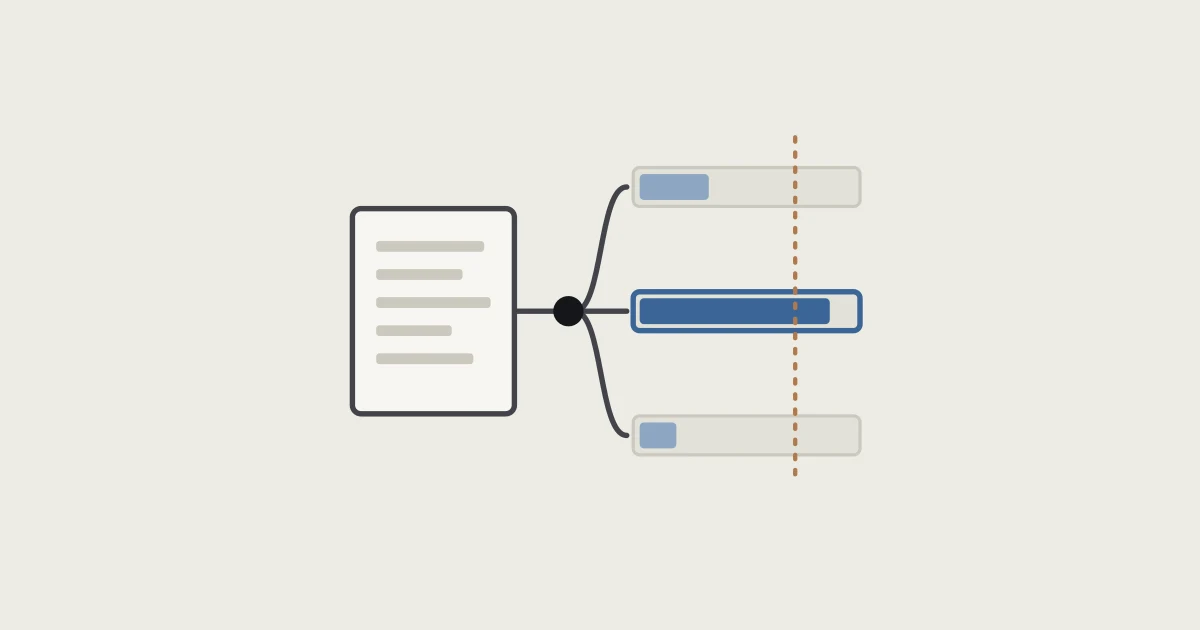
A decision model is built for that kind of question. You send it some input and the options. It returns a probability for each option. It writes no text.
What a decision model is
TypeSafe launched Jev, a hosted decision model, on 15 September 2026. Others followed within weeks. Liquid AI released d1. Cloudflare released Clef and later faster versions and one that also takes audio and video. AWS released Strands Decider, an open model that runs locally. Microsoft put Microsoft-Decision-1 on Foundry and OpenRouter. OpenAI announced a Decisions API.
TypeSafe’s documentation describes three kinds of question. A yes/no question returns the probability of yes. A choice question returns a probability for each option in a list. TypeSafe states a limit of 255 options per question. A score question returns a value on a scale.
How it differs from asking a large model
An LLM writes an answer and your code reads it. A decision model returns a number for each option. Your code compares that number with a threshold you set. Above it, the code goes ahead. Below it, the case goes to a person or to a larger model.
The options are written in the request, so a label can change without retraining. How well the model handles the new label is something to test.
The vendors and testers also report speed and cost. TypeSafe states a response time of 70 to 500 ms for Jev. In Arize’s tests, hosted decision models took a median of 0.08 s to 0.50 s per check. One open-source macOS agent reports $0.0002 per decision with Jev, against $0.032 with Claude Opus reading a screenshot. These are the project’s own figures.
Sebastian Raschka tried Jev on IMDb film reviews, with no training examples. It labelled 96.5% of the reviews correctly. A simple word-count classifier trained on the reviews scored about 89.9%, and a ModernBERT model fine-tuned on the reviews about 95%. He notes that the test reviews may have been in Jev’s training data.
A rule of thumb
A decision model is worth trying when you can list the options before you see the input, and picking one needs judgment. Plain code is enough when you also know the rule, such as “more than 30 days late goes to collections”. An LLM is still needed when the answer can’t be listed in advance, such as the reply itself.
A system can use all three. Code holds the steps and the data. A decision model picks at each fork. An LLM writes the free text. TypeSafe’s documentation suggests asking each factor as a separate question, then combining the answers in code.
Decisions it suits
Vendors and independent testers describe these uses. Each one still needs testing on your own cases.
- Routing. Which team gets this ticket? The model picks one team from your list.
- Labelling. Is this file an invoice, a contract or a CV? The model picks one type, and code files it.
- Moderation. Is this post allowed, does it need review, or should it be blocked?
- Picking a tool. An agent can search, calculate or open a calendar. The model picks the tool that runs next.
- Topic tags. One yes/no question per topic, all in the same call. Each answer stands on its own, so an email can be about billing and about delivery.
- Checks before an action. Is this reply safe to send? Is this input a prompt injection, meaning text written to take over the model?
- Loop exits. An agent has tried a step. The model picks whether it keeps going, retries, stops or asks a person.
- Form slots. Has the customer given a date yet? If not, the bot asks for one.
- Scores. How urgent is this message on a scale? The score picks the queue.
- Judging answers. Is this answer backed by the source it cites?
- Relevance. Should this passage be kept or dropped before an LLM reads it?
- Computer use. Each screen has its own buttons and fields. The model picks which one to click.
If you already run a chatbot with an intent classifier, you can keep the flow and swap that classifier for a decision model.
The Decision Index
The Jev Decision Index is a community leaderboard on Hugging Face. It gives every model the same public and private tests and scores each one from 0, which is random guessing, to 100, which is perfect.
A score on a general index says little about one specific decision of yours. Use it to pick which models to test.
Where it does not fit
- The answer is text, such as replies, summaries and code.
- You need a value from the input, such as a name or an amount. A decision model scores only the options you give it.
- Nobody can list the steps in advance, as in open research or planning a new task.
- You already know the rule. Plain code is cheaper and gives the same answer every time.
- There are millions of options, such as every product in a catalogue. Search first, then let a decision model pick from the top few.
A classifier trained on your own data may also be enough. In Red Hat’s prompt-injection test, a DeBERTa model of about 200 million parameters ran on a laptop CPU. It was right 89.0% of the time, against 86.4% for Jev. Red Hat concluded that Jev does not reliably beat such alternatives. Raschka makes a similar point: on a narrow, fixed task, Jev probably won’t beat a classifier built for it.
Test it like any classifier
- Ask each question both ways. In Arize’s tests, Liquid’s d1 scored 0.92 on “Is every claim supported?” and 0.17 on “Does it contain an unsupported claim?” (ROC AUC, where 0.5 is chance). Jev, Cloudflare’s Clef and OpenAI’s model held steady.
- Check the confidence on unfamiliar input. In a Synthpop study, on yes/no questions about news from late 2024 onwards, Jev was right 51% of the time while its confidence rose to 82%. AWS’s Marc Brooker told TechCrunch that pushing a model on accuracy and on calibration (whether its confidence matches how often it is right) takes a careful balance.
- Set your own thresholds. Choose them on your own labelled cases, according to what a wrong answer costs you.
Try this
Find one place where your code asks a large model a question with a fixed set of answers. Write the options down and add “none of these”. Collect fifty real cases with the right answer. Run them through a decision model and through your current setup, and ask each question both ways. If the decision model holds up, choose the threshold above which its answer may act on its own.
If you don’t have time to set this up, it’s what we do in AI evaluation.
Sources
- TypeSafe, Introducing System One models and Jev, September 2026. typesafe.ai
- TypeSafe documentation (accessed October 2026). docs.typesafe.ai
- Liquid AI, d1, 2026. liquid.ai
- Cloudflare, Clef decision models, 2026. blog.cloudflare.com
- Cloudflare, an update to the Clef models, 9 October 2026. blog.cloudflare.com
- Microsoft, Microsoft-Decision-1 on Foundry, October 2026. commandline.microsoft.com
- TechCrunch, on OpenAI’s Decisions API, 30 September 2026. techcrunch.com
- TechCrunch, on AWS’s Strands Decider, 1 October 2026. techcrunch.com
- Arize, decision model benchmark, 2026. arize.com
- typesafe-computer-use, an open-source macOS agent. github.com
- Sebastian Raschka, on the history of classifiers and Jev, 2026. magazine.sebastianraschka.com
- Jev Decision Index, a community leaderboard on Hugging Face (version 0.3). huggingface.co
- Red Hat, decision models against traditional guardrails, October 2026. developers.redhat.com
- Synthpop, does a decision model know when it is guessing?, 2026. synthpop.ai